A comet is a small object in space made mostly of ice, dust, and rock. When a comet gets close to the Sun, its ice starts to melt and turns into gas, forming a glowing cloud and a long tail that always points away from the Sun. Comets often come from very far regions of the solar system and follow long, stretched-out paths.
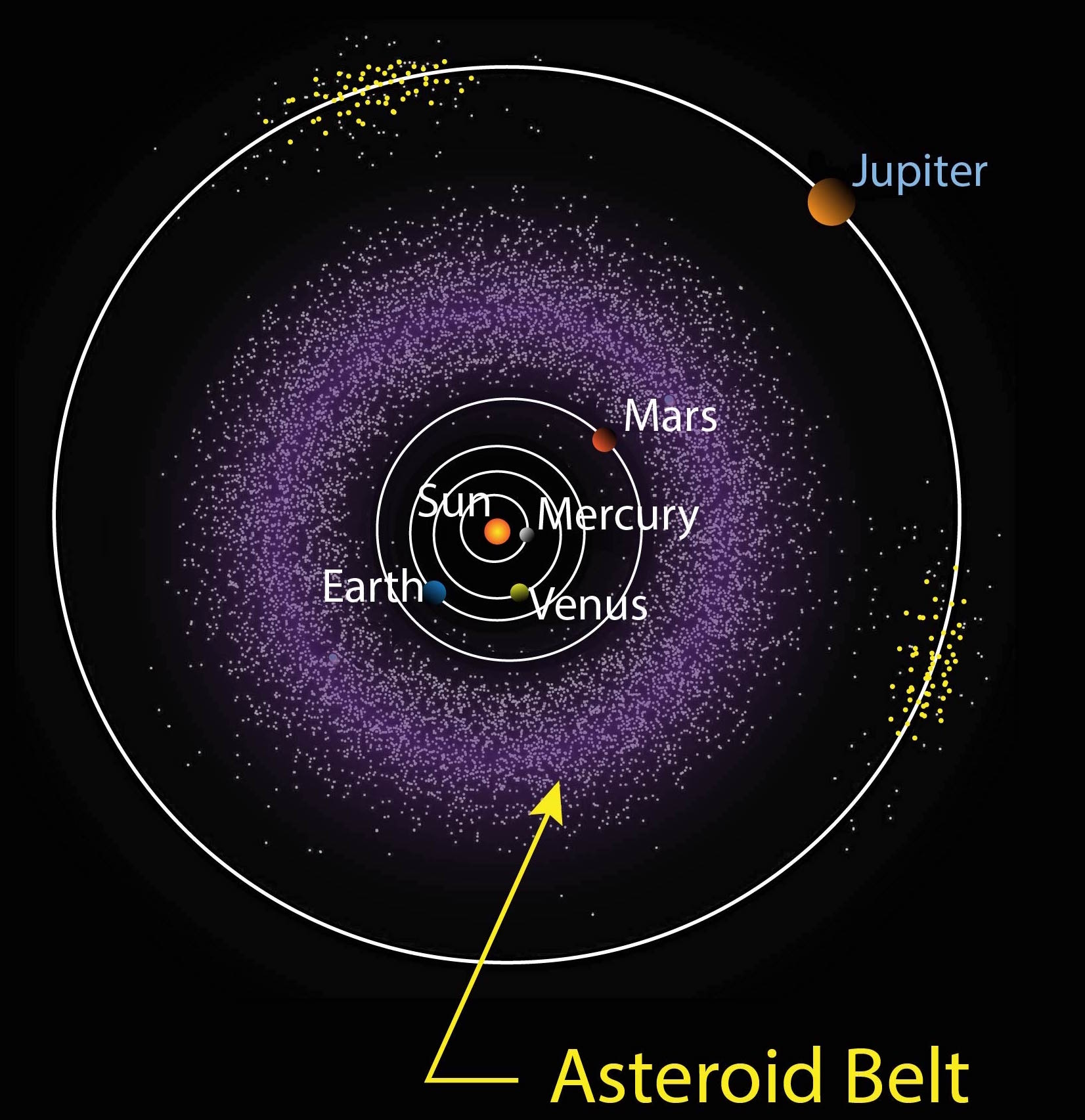
Whereas, an asteroid is a rocky or metallic object that moves around the Sun, usually in the asteroid belt between Mars and Jupiter. Unlike comets, asteroids do not have tails because they don’t contain much ice and don’t change when near the Sun.
| Feature | Asteroids | Comets |
|---|---|---|
| Material | Rock or metal | Ice, dust, and rock |
| Tail | No tail | Has a tail when near the Sun |
| Location | Mainly in the asteroid belt | Kuiper Belt or Oort Cloud |
| Orbit | More circular or oval | Long, stretched (elliptical) |
| Appearance | Solid and rocky | Bright and fuzzy near the Sun |
| Activity | Inactive | Active near the Sun |
They are often confused with each other, but they have differences as given above.
Fun fact!
Asteroids are also called minor planets, and they were formed then our solar system was just born!Comets can have two tails — one made of gas and one made of dust — and both always point away from the Sun, but in slightly different directions. The gas tail is pushed straight back by the solar wind, while the dust tail curves a bit due to the comet’s motion. It’s like a space object with a double trail behind it.
Comets are icy bodies that travel through space, often from very distant regions of the solar system like the Kuiper Belt or the Oort Cloud. These areas are far beyond the planets and contain many frozen objects left over from the early days of the solar system. A comet is made mostly of ice, dust, and rock. When it’s far from the Sun, it looks like a dark, frozen lump. But as it gets closer to the Sun, the heat causes the ice to turn into gas. This gas, along with dust, forms a glowing cloud around the comet called a coma. The solar wind — a stream of particles from the Sun — pushes this material away, creating a long, bright tail that always points away from the Sun. Some comets have two tails: one made of gas and one made of dust. These tails can stretch for millions of kilometers and make comets visible from Earth, even without a telescope. Comets move in long, stretched-out orbits, which means they only visit the inner solar system once in a very long time — sometimes taking hundreds or even thousands of years to return. Because of this, seeing a bright comet in the sky is a rare and special event.
Asteroids are rocky objects that orbit the Sun, mostly found in a region called the asteroid belt between Mars and Jupiter. This belt is like a wide, scattered zone filled with leftover pieces from the early solar system — bits that never formed into planets. Asteroids come in many shapes and sizes. Some are small like pebbles, while others are hundreds of kilometers wide. They are made mostly of rock or metal and don’t have ice like comets do. Because of this, asteroids don’t grow tails or glow when they get close to the Sun — they stay solid and quiet. Most asteroids follow fairly round or oval paths around the Sun, and many have been studied up close by spacecraft. Some even come near Earth, and scientists keep a close watch on them to make sure they don’t pose a danger. Studying asteroids helps us learn what the solar system was like when it first formed, since these space rocks are like time capsules from billions of years ago
*Some of the parts of the website is inspired by NASA's official website* Designing ideas credit goes to NASA (Respect!)